"New" Star in our Neighbor Galaxy

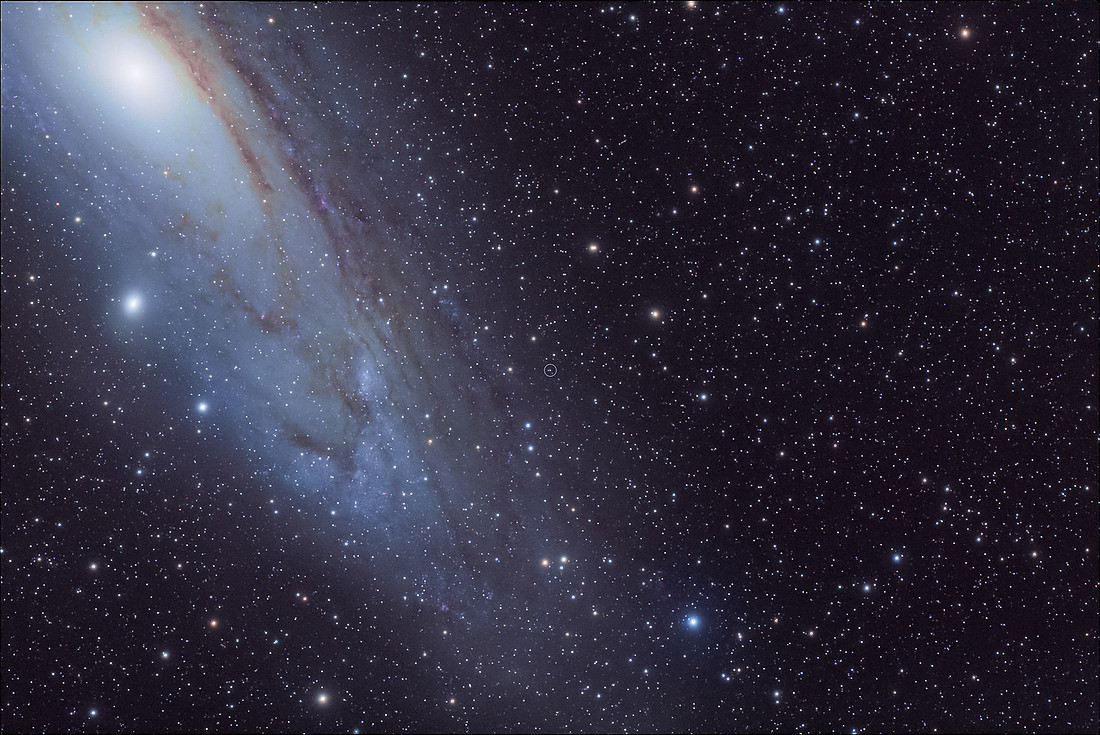
 The Andromeda Galaxy (also known as M31) is our nearest neighboring large spiral galaxy, much like the Milky Way where we live, some 2½ million light years away. Recently a "new" star was discovered in M31, dubbed AT2025abao. It's not truly new, but suddenly bright enough to be detected from Earth. This object is classified as a luminous red nova (LRN), much fainter than a supernova, but brighter than a classical nova, thought to be caused by the merger of two stars.
This image was made on November 21, 2025 from southwestern New Mexico and includes much of M31 as well as one of its much smaller companion galaxies, M32, the fuzzy spot below the bright core of M31. The location of the nova is marked by a small circle in the middle of the image, and in the cropped detail below.
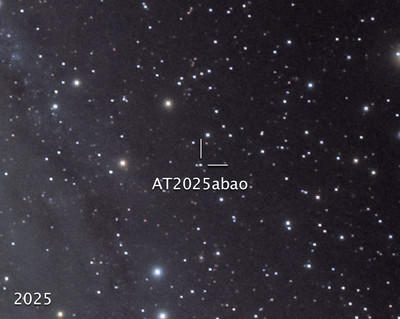
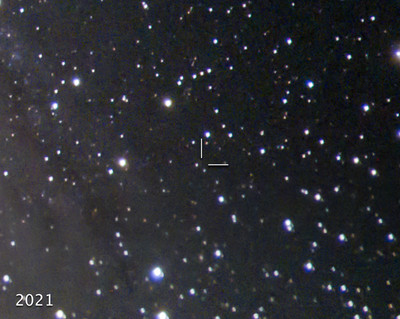
Compare this with an image of the same region I made in 2021 in which the nova is not visible.
I was excited to catch such a faint transient event that took an astonishing 2½ million years for the light to reach us.
Technical details:
2025 M31 image: 10 exposures 360 sec. each (1 hour total) from Gila, New Mexico, November 21, 2025
Telescope: Explore Scientific ED102 102mm f/7 apochromat refractor, Explore Scientific 1x flattener
Camera: ZWO ASI2600MC Pro cooled color CMOS
Mount: iOptron CEM25P
Automation: ZWO ASIAir Pro controller, ZWO EAF autofocuser, SVBONY SV2165 30mm f/4 guide scope, ZWO ASI120MM Mini guide camera
Processing: Astro Pixel Processor, Lightroom, Photoshop