A Gamble that Keeps Paying Off

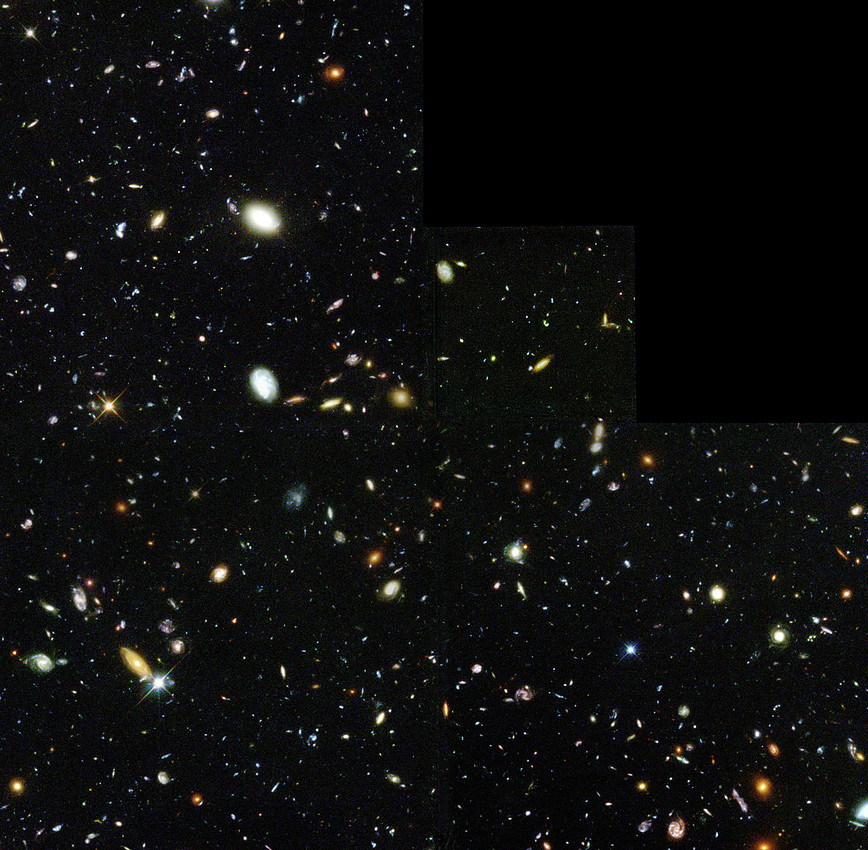

It occurred to me that it's been 30 years (!) since this groundbreaking image was made. Known as the Hubble Deep Field (HDF), it was made from observations by the Wide Field Planetary Camera 2 (WFPC2) on NASA's Hubble Space Telescope (HST) of a small patch of sky in the constellation Ursa Major (the Big Dipper). 342 exposures were made by Hubble over 10 days in late 1995, for a total of 141 hours. The story of the proposal, planning, observation, data processing, analysis, numerous followup observations, and science results is complex, fascinating, and a glimpse into cutting-edge, world-class science (and too long to get into much more detail here, but many resources are available elsewhere).
https://science.nasa.gov/mission/hubble/science/universe-uncovered/hubble-deep-fields/
https://iopscience.iop.org/book/mono/978-0-7503-1756-6
I feel honored to have had a small part in producing the image — at the tail end of the process — after long and diligent work by the remarkable science team, including developing new software to enable combining the data in a way to optimize the detail. From four, combined images using different filters spanning the range of color sensitivity of the camera, I assembled the color image. The greatest challenge was to reproduce in the public image as much information as possible that was in the data without over-processing or introducing artifacts or emphasizing noise that would detract from the science story — the most significant features are just barely above the background noise. Though the image is relatively small by today's standards (2.5 megapixels), the state of computer hardware and software was much different 30 years ago, which contributed to the processing challenges.
Another hurdle was producing the image in time for its unveiling and announcement at the January 1996 meeting of the American Astronomical Society, only a few weeks after the observations were made. Making this ambitious timeline even more stressful was the arrival of a major East Coast snowstorm just before the meeting; I was snowed in at home for a few days just as I had to deliver a file on a physical disk from our office in Baltimore to a lab to print a giant display poster for the meeting (in the days before widespread high-speed internet). But we made the timeline and the assembled astronomers were duly impressed by the results. https://science.nasa.gov/missions/hubble/hubbles-deepest-view-of-the-universe-unveils-bewildering-galaxies-across-billions-of-years/
The HDF started out as something of a gamble by Robert Williams, the Director of the Space Telescope Science Institute then. Who would have thought that a small patch of sky with no significantly bright objects would actually contain thousands of distant galaxies and help us understand so much about the development of the early universe? Though the image may not be as visually spectacular as many others from Hubble, the science observations have turned out to be one of the signature legacies of Hubble, and has now been followed up and augmented by observations from the James Webb Space Telescope and many other observatories; a gamble that keeps paying off.