An Asteroid Activates

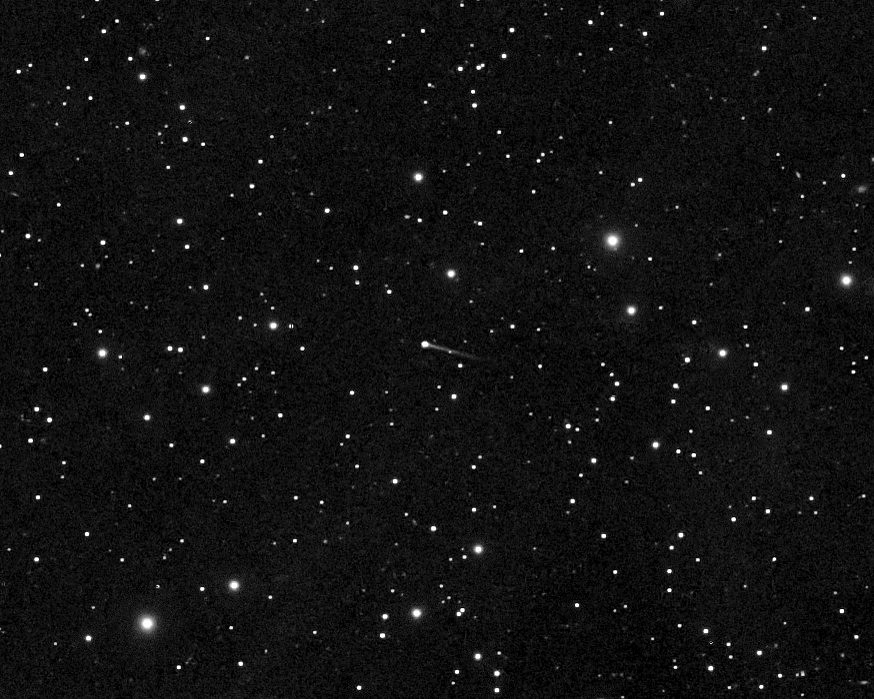
 Here's something unusual: an asteroid has developed a comet-like tail. Comets are a mix of ice and rock that spend most of their time far out in the Solar System. They can develop a bright tail as the ice evaporates when they approach the Sun and the debris is illuminated and pushed away by the solar wind. Asteroids are mostly rock so rarely lose visible debris. Astronomers working with the Zwicky Transient Facility noticed that this asteroid, known as 6993 (1995 BJ4) has developed a visible, albeit faint tail. See more information on this, including ideas about why the tail formed at EarthSky.org, or the technical paper at arXiv.
Since I had seen some images posted online I thought there might be a possibility that I might capture this with my more modest equipment. And sure enough, it's there in the center of the image, though barely visible. The image is a composite of many exposures taken over two nights. I used a color camera but converted to black & white; there's very little color apparent in the asteroid, though the stars do vary quite a bit in color.
115 300 sec. exposures (9 hr. 35 min. total) from Suburban Bloomington, Indiana (Bortle 5)
Explore Scientific ED102 102mm f/7 apochromat refractor, Explore Scientific 1x flattener
ZWO ASI2600MC Pro cooled color CMOS camera, ZWO UV/IR cutoff filter
ZWO EAF autofocuser
SVBONY SV2165 30mm f/4 guide scope, ZWO ASI120MM Mini guide camera
ZWO AM5N mount
ZWO ASIAir Pro controller
Processed in Astro Pixel Processor, Lightroom, Photoshop