The Magnificent Rosette

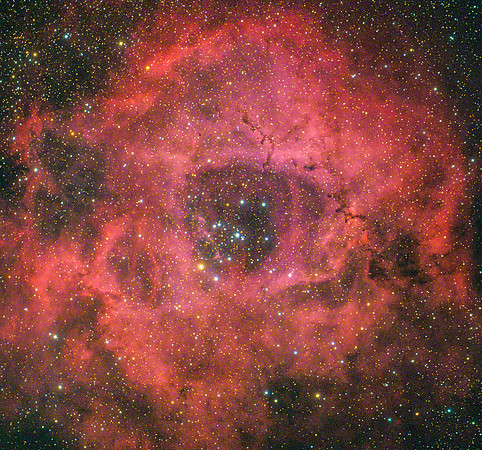

The Rosette Nebula (NGC 2238) is a perennial favorite deep sky target. This is a composite of images made with both a monochrome and color camera. The monochrome shows a lot of detail in the nebula without over-saturating the stars, while the color image brings out the color of the stars but loses some of the detail in the nebula.
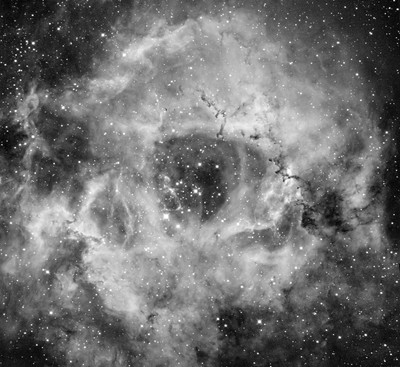
Mono: 53 exposures, 360 seconds each in 6 overlapping tiles, flats, darks, dark flats, bias calibrations
GSO 8" f/8 RC OTA
ZWO ASI2600MM Pro cooled monochrome CMOS camera, SVBONY H-alpha (Hα) 7nm filter
Losmandy GM811G mount, ZWO ASIAir Plus controller, ZWO EAF autofocuser
auto-guided, Askar off-axis guider, ZWO ASI174MM Mini guide camera
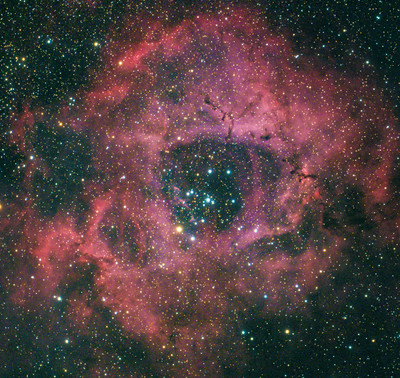
Color: 100 exposures, 60 seconds each in 2 tiles, flats, darks, dark flats, bias calibrations
Explore Scientific ED102 102mm f/7 apochromat refractor, Explore Scientific 1x flattener
ZWO ASI2600MC Pro cooled color CMOS camera, ZWO UV/IR cutoff filter
iOptron CEM25P mount, ZWO ASIAir Pro controller, ZWO EAF autofocuser
auto-guided, SVBONY SV2165 30mm f/4 guide scope, ZWO ASI120MM Mini guide camera
The composite is able to pretty much preserve the best of both. There's more to be done to render more color in the nebula but that requires more (rare) clear nights.
Mono and color FITS frames were calibrated, registered, and combined separately in Astro Pixel Processor. The two combined FITS images were registered in APP, stars removed from the mono h-alpha image and saved as TIFF, which were loaded in separate layers in Photoshop (see attached). Color was applied to the h-alpha layer using Hue/Saturation adjustment layer in Colorize mode (hue=17, saturation-68, lightness=-50, some subjective judgement here), with Screen layer blend mode. Additional brightness, contrast, etc. adjustments were made in Lightroom.