A Postcard from Very DEEP Space

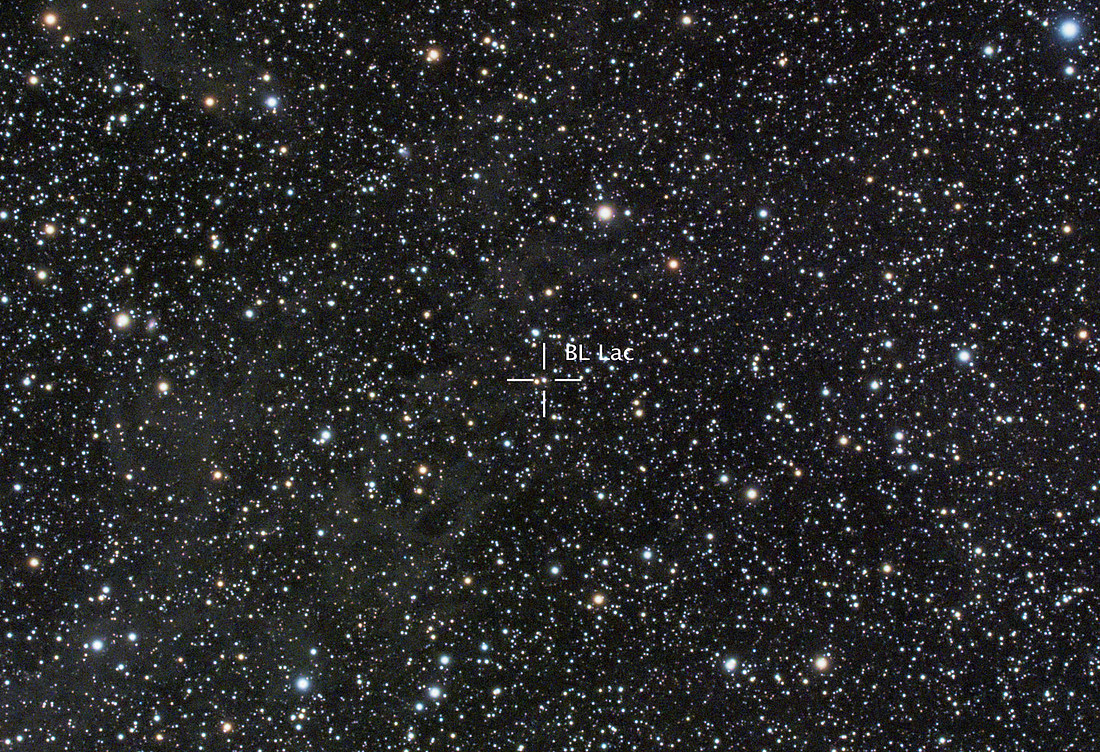

Yes, it's filled with stars. But one star in particular has a pretty interesting story, and I was especially pleased that I could get a photograph.
Pretty much anyplace you point a telescope in the sky, you can see or photograph a multitude of stars of different brightness and color. They also have greatly varying temperature, mass, distance, and many other properties, mostly very different from the nearest star to us, the Sun. All stars are huge balls of mostly hydrogen gas, converting hydrogen to helium through nuclear fusion and pouring out copious amounts of energy, mostly in the form of light. The stars in this picture are all within our home galaxy, the Milky Way and are at most a few 10s of thousands of light-years away.
But this image contains one very different object, though it looks just like a star. It's known to astronomers as BL Lacertae or BL Lac for short. First of all, it's not a star at all but an entire galaxy composed of perhaps many billions of stars, gas, dust and other material. In that respect it's a lot like our own galaxy. But it's also very different. It's also extremely far away, some 900 million light-years, or a million or so times the distance to most of the stars in our galaxy. That's why it looks like a star; it's so far away we cannot see the extent of the galaxy, even with very powerful telescopes. But if it's so far away why can we see it at all, especially in this image, taken with very modest equipment from my back yard. What we are actually seeing is light produced by the galaxy's nucleus, the central core. This particular galaxy is pouring out vast amounts of energy because it contains an extremely massive black hole in the center. (In fact, most galaxies, including the Milky Way have a massive black hole at the center, but this one is especially massive and active.) Despite that vast outpouring of energy, it's still a fairly obscure pinpoint of light in our sky because it's so far away, much fainter than we can see without a telescope.
Wait, isn't the primary characteristic of a black hole that nothing can escape, not even light? Yes, though there's a lot of material: gas, dust, stars, planets, etc. very near the black hole, and as it swirls around in the extremely strong gravitational field it gets heated and interacts with extremely strong magnetic fields and generates vast amounts of energy that we ultimately detect as light.
BL Lac was first described nearly 100 years ago as a variable star. It stood out because it varies in light irregularly. Unlike many stars that vary in a regular pattern of brightening and dimming, BL Lac's brightness is unpredictable. Not until the 1960s when radio telescopes detected BL Lac did astronomers begin to understand that it belongs to the class of objects known as Quasi-Stellar Objects — QSOs or Quasars.
I was inspired to make this image with the passing a few years ago of Maarten Schmidt, the astronomer who first measured the distance to a quasar (3C 273) in 1963, ushering in a new era in studying the distant universe. And recalling that I studied BL Lac briefly for a public talk many years ago as a graduate student. Who would have thought those decades ago that I could get an image of it with a small telescope from my back yard in suburban Bloomington, Ind.
Tech details:
24 total exposures, 5 min. each (total 2 hours). Explore Scientific ED102 102mm f/7 refractor, 0.8x reducer/flattener, ZWO ASI294MC cooled one-shot color CMOS camera, UV/IR cutoff filter, iOptron CEM25P mount, ASIAir controller, auto-guided. Processed in Astro Pixel Processor and Lightroom