An interesting juxtaposition

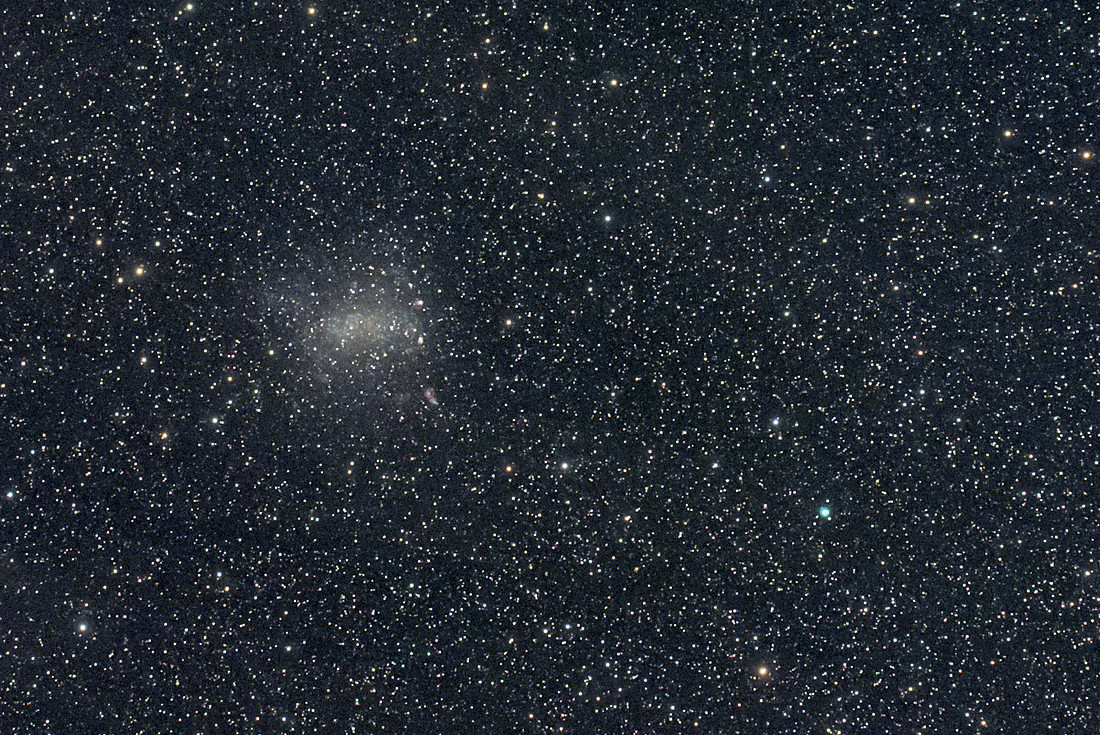

Many objects appearing close to each other in the sky are in fact quite far apart.
Here's an extreme case: The fuzzy blob is a galaxy, an assemblage of many billions of stars and gas located about 1.6 million light-years from us. It's classified as a dwarf irregular galaxy since it's small, unlike most other galaxies, including the Milky Way in which we live, and it has no regular structure, again unlike the Milky Way which has a well-defined spiral structure.
The bulk of the points of light in the image are stars located in the Milky Way, located a few hundred to a few thousand light-years away.
Among the field of stars is a greenish disk that's also in the Milky Way 6,400 light-years away, but is not a star. It's a shell of gas surrounding a star that blew off its outer layers when it ran out of the hydrogen fueling its energy production. The gas is energized by the hot remnant of the star, which we don't actually see here.
Tech details:
Dwarf Irregular Galaxy NGC 6822 and Planetary Nebula NGC 6818, October 24, 2025 from Goose Pond Fish & Wildlife Area, Greene County, Indiana
10 exposures, 300 sec. each
Explore Scientific ED102 102mm f/7 apochromat refractor
Stellarvue 0.8x reducer/flattener
ZWO ASI2600MC Pro cooled color CMOS camera, gain 100, bin 2, -10ºC
IDAS DTD light pollution filter
ZWO EAF autofocuser
iOptron CEM25P mount
ZWO ASIAir Pro controller
Auto-guided, SVBONY SV2165 30mm f/4 guide scope, ZWO ASI120MM Mini guide camera
Processed in Astro Pixel Processor and Adobe Photoshop Lightroom